

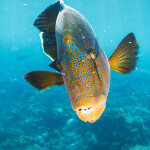

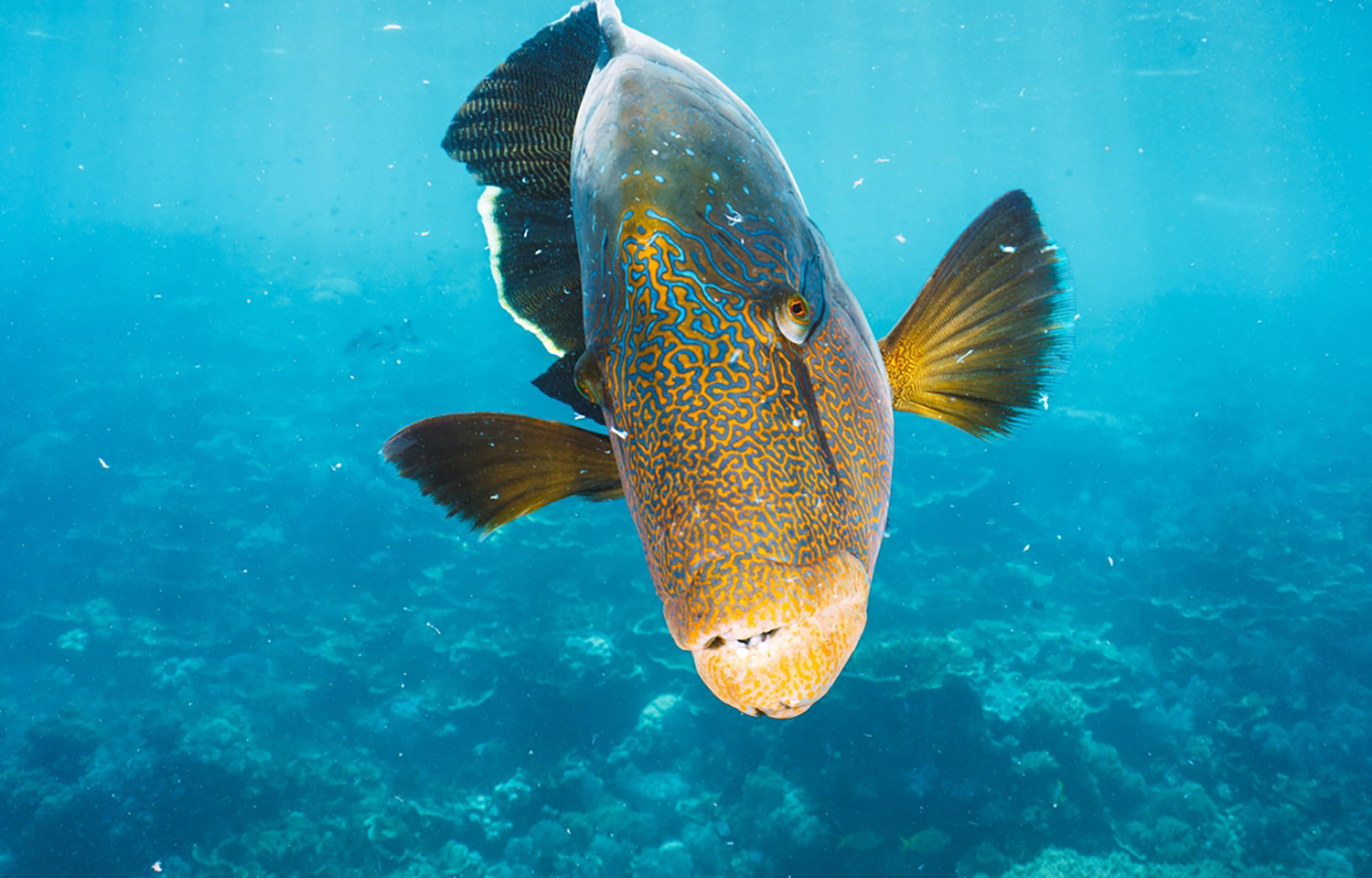
Indonesia is the only country in the world that allows legal exports of humphead wrasse, and with shipments experiencing a recent uptick, conservationists sounded alarms over the sustainability of the tropical reef species.
“After introducing ranching in 2018, Indonesia has enormously increased its export quotas for humphead wrasse without any biological justification,” said Yvonne Sadovy, a professor at the University of Hong Kong and a tropical reef fish expert. “For 2026, exports permitted are 3,400 wild and 15,000 ranched humphead wrasse; this is way above what was permitted previously, which was about 1,000 to 3,000 fish per year.”
The ranching to which Sadovy alludes is a mariculture framework Indonesia introduced eight years ago; under the framework, harvesters capture juvenile wrasse from the wild and raise them in sea cages.
Humphead wrasse is listed as a protected species under the Convention on International Trade in Endangered Species of Wild Fauna and Flora (CITES), but limited amounts of international trade are acceptable as it’s listed under its Appendix II protected level. Appendix II includes species that, while not fully at risk of extinction, could be at risk if international trade is left unmitigated.
More specifically, Indonesian trade of humphead wrasse takes advantage of CITES source code “R,” which refers to animals reared via ranching and allows trade of species raised “in a controlled environment,” particularly designated for “animals taken as eggs or juveniles from the wild where they would otherwise have had a very low probability of surviving to adulthood.”
According to a 2023 study published in Marine Policy, the main issue with humphead wrasse ranching is that these “animals are still wild-caught, but the fishery for animals destined for ranching is uncontrolled and has not been subject to a [non-detriment finding] that considers biological factors.”
“Hence, ranching could be having a negative impact on wild populations,” the study said, explaining that there is no scientific backing that the humphead wrasse captured for ranching purposes would have trouble surviving to adulthood if left alone.
Similarly, Sadovy claimed the “R” designation was “misapplied” to humphead wrasse and, as such, “represents a further threat to the species.”
“In practice, capture-based aquaculture operations involve the uncontrolled and unmanaged capture from the wild of large numbers of individuals which are then grown to market size,” she said. “Any fish labeled as ‘R’ is subject to much lower scrutiny than ‘W’ [wild] labeled fish because ranched animals … are treated like farmed and not wild animals and yet they come from the wild and need a [non-detriment finding].”
Nations like the Maldives, Fiji, Palau, and Australia have long banned exports of humphead wrasse to prevent overfishing of the species. Other nations like Malaysia and the Philippines have also banned exports, but the former market still allows domestic trade, which has resulted in a recent influx of tourists to the country who want to dine on the species, and the former market continues to be an alleged hotbed of illegal, unreported, and unregulated (IUU) production of tropical reef fish such as humphead wrasse.
Demand for the species predominantly comes from Hong Kong, where the fish is prized in high-end seafood restaurants.
Jakarta, Indonesia-based seafood trader and consultant Arie Prabawa told SeafoodSource that shipments of reef fish from Indonesia to Hong Kong remain strong because of the high prices available.
“The retail prices in Hong Kong have gone up to USD 275 (EUR 245) per kilogram recently,” he said. “I have had some buyers recently in Hong Kong and mainland China for humphead wrasse, but I think China has now stopped, so only Hong Kong is able to accept it.”
According to multiple reports, the city facilitates massive trade in live reef fish by allowing shipments in and out that have little or no traceability information attached.
“Endangered species like humphead wrasse are in Hong Kong markets but are missing from trade data due to underreporting from fishing vessel declarations and incomprehensive surveys … leading to over 50 percent import data gaps in half the live reef food fish species,” a 2024 report said.
Even though some of that trade is legal, Sadovy said the lower scrutiny Hong Kong officials lend toward ranched wrasse, albeit intended to make legal trade more efficient, “also makes illegal trade easier.”
Indonesian authorities seized a ship in the Sulawesi Sea earlier this year and discovered over 1 ton of live wild humphead wrasse destined for Hong Kong that did not have required permits. The fish was “concealed inside a specially modified compartment designed to avoid detection during inspections,” per The Online Citizen.
“That is a lot of fish for this species, [especially] compared to recent past annual export CITES quotas, and this was just one shipment,” Sadovy said.
Sadovy further explained that the power of Hong Kong authorities to crack down on the issue is weakened by the CITES designations currently in place.
“I don't know what specific steps the [Agricultural Fisheries and Conservation Department of Hong Kong] is taking, but they are certainly doing some monitoring of retail outlets. However, their power is weakened by the situation for ranched imports which now form the majority of the trade,” she said.
Sadovy said some work is starting to be done on CITES’ end to look into the possible misapplication of the “R” source code.
“There is now a working group being organized under the CITES Animals Committee to address the whole ranching issue, [using] Indonesia as a case of major concern,” she said.
