


Two Japanese start-ups are reporting success farming purple sea urchins.
Urchinomics and Kita-Sanriku Factory Inc. both attended the Osaka Seafood Show on 13 and 14 April, 2022, in Osaka, Japan.
Urchinomics, which raised JPY 630 million (USD 5.7 million, EUR 4.9 million) in a Series A funding round in April 2021, is in the process of building commercial-scale urchin ranches in Japan, North America, and Norway. Urchinomics harvests undersized or under-filled sea urchins and feeds them a proprietary feed for six to 12 weeks to enhance their roe (uni in Japanese), and then sells it to fine-dining restaurants.
While much urchin roe is imported to Japan from Chile, the in-shell market it mainly supplied either from domestic or Russian sources, according to Urchinomics Operations Manager Hirotaka Nishi. Nishi said prices for urchin roe are higher now due to interruptions to Russian supply.
Urchinomics has developed a sea urchin feed and feeding system in which urchins that are mostly empty due to lack of feed are moved to land-based tanks and fed on a processed, kelp-based feed. The system has the advantage of stable year-round supply and pricing, allowing for four to five cycles of feeding to be done in a year using the same equipment.
Urchinomics is aiming for annual production of 36 metric tons (in-shell basis), according to Nishi.
“The cap-ex is high, but based on the variable cost only, it is profitable,” Nishi said.
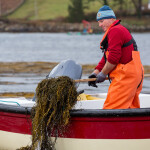
Urchinomics contractor Evah, based in Nagatoshi City, Yamaguchi Prefecture, Japan, was also at the Osaka show. Evah is a seaweed processor specializing in the brown macroalgae Sargassum horneri (akamoku), and has found a niche business supplying the sea urchin farmer.
Separately, Kita-Sanriku Factory, which does “urchin ranching” rather than farming, recently started exporting to Singapore, Hong Kong, and Vietnam.
The company's CEO, Yukinori Shitautsubo, told SeafoodSource the company has a bifurcated business model. From April to August, it sells urchins it raises on the natural seaweed in the tide pool, and in the autumn and winter it provides kelp feed to its urchins, similar to the Urchinomics method.
Shitautsubo's grow-out method for its urchin differs greatly than that of Urchinomics. The company, which has been in business for 55 years, spawns its urchins in a tank and puts them into the ocean for grow-out. Divers then retrieve them at a later stage and move them to the tidal pools for the final stage of growth. The high school near the company teaches diving, enabling the company to hire local students to do the work, Shitautsubo said. It takes about five years for the urchins to mature from the seed stage.
The company's urchin feed is a byproduct of the kelp industry. Kelp is harvested in Japan to make dried konbu, which is used for soup stock. But the lower portion where the kelp is attached to the sea floor is not used for this. This is the part Kita-Sanriku Factory uses to make urchin feed.
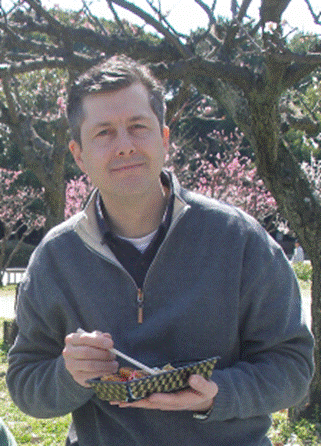
Photo courtesy of Chris Loew/SeafoodSource
