



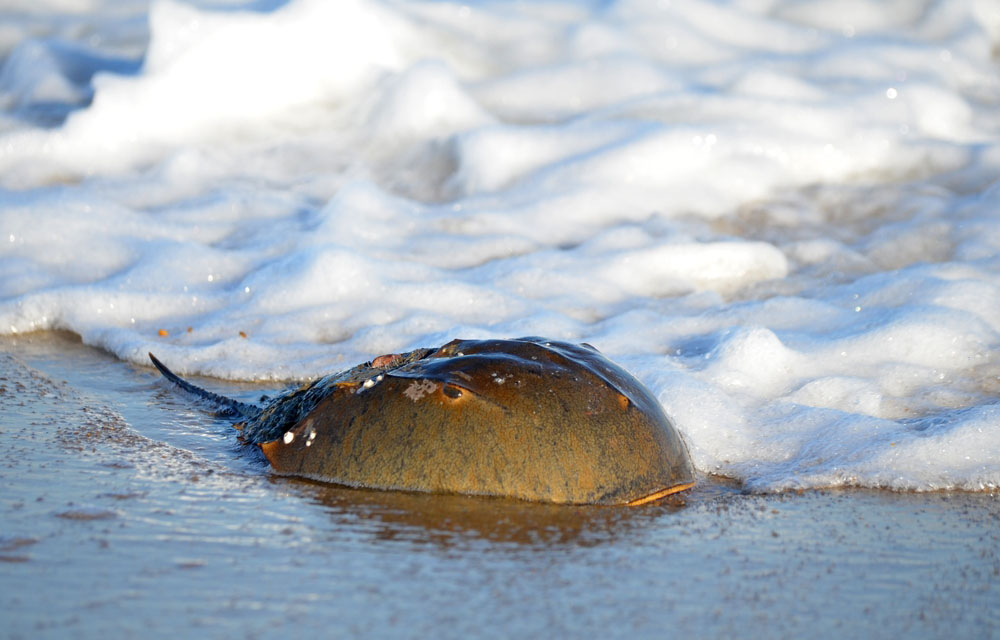
The Center for Biological Diversity (CBD) has sued NOAA Fisheries to secure Endangered Species Act (ESA) protections for horseshoe crabs, just months after the agency denied their petition.
“Horseshoe crabs have survived meteor impacts and ice ages, but they’re facing their biggest threat yet: us,” CBD Senior Attorney Danny Waltz said in a release. “It’s deeply upsetting that the Trump administration is unwilling to save these living fossils from extinction. I’m hopeful this lawsuit will force federal officials to act before it’s too late.”
Horseshoe crabs are both harvested for use as bait and drained for their blood, which is highly valued for its use in the biomedical industry, but synthetic alternatives are increasingly available. CBD claims that horseshoe crab populations have declined by 70 percent “in recent decades” and, in 2024, petitioned NOAA Fisheries to list the species under the ESA.
However, NOAA Fisheries blew past the deadline for the mandatory 90-day finding on the petition, and CBD sued the agency in January 2026 to force it to act on the petition.
NOAA Fisheries finally issued its 90-day finding in February 2026 – roughly two years after the petition was filed – finding that the species populations remain stable.
“Overall, across the species' range, most regional populations are considered to be stable or increasing with the exception of the New York regional population,” NOAA Fisheries stated. “We conclude the petitions do not present substantial scientific or commercial information indicating that the petitioned action to list [horseshoe crab] as a threatened or endangered species may be warranted.”
Now, CBD has filed suit in the U.S. District Court for the District of Columbia, challenging NOAA Fisheries’ 90-day finding.
“NOAA Fisheries’ negative 90-day finding made in essence a 12-month finding but without the agency first performing a species status review and providing all interested parties with procedural opportunities that accompany a 12-month review and finding,” the lawsuit states. “NOAA Fisheries’ negative 90-day finding is arbitrary, capricious, and unlawful.”
According to CBD, NOAA Fisheries erred in dismissing the evidence presented in the petition, relying on third-party information to inform its 90-day finding, and “arbitrarily” determining that there was no significant area where a listing of horseshoe crabs under the ESA was warranted. The organization has asked the court to vacate the 90-day finding and order NOAA Fisheries to conduct a new one.
“Horseshoe crabs are vital to coastal animals and communities, and they are vanishing from our shores on our watch,” Waltz said. “Fortunately, the Endangered Species Act can save horseshoe crabs but only if the Trump administration does the right thing and grants them lifesaving protections.”
